Tackling Social Issues through Collaboration with Startups
The Future of Infrastructure Enabled by Cutting-Edge Robotics
Apr. 01, 2026
Mitsubishi HC Capital is moving beyond our traditional boundaries of leasing and finance to take a full-scale approach to resolving social issues through technology. Driving this initiative is the Robotics Business Development Department, established in April 2024. As one example of addressing social issues, the department has partnered with Solaris Inc. (hereinafter "Solaris"), a startup that has developed a cutting-edge robot for pipe inspection and cleaning, to launch a subscription-based inspection service. Ken Tozuka, who leads this project, shares the details of the service and its future potential.
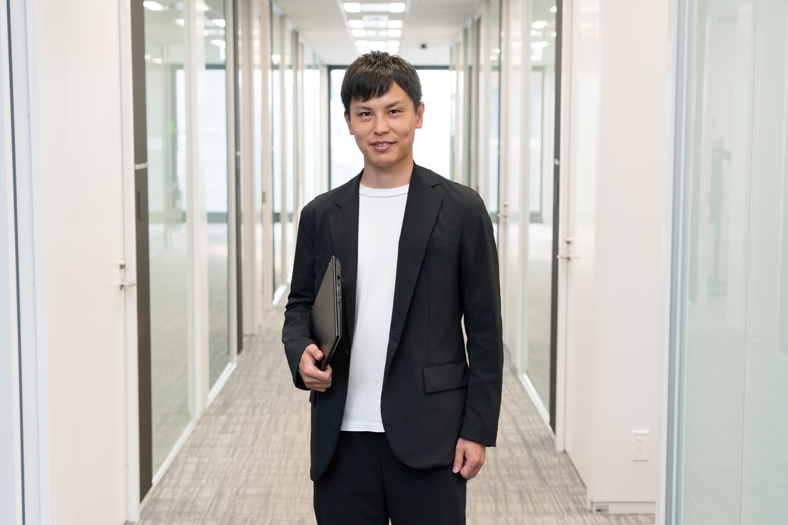
Ken Tozuka, concurrently serving in the Project Acceleration Department and Robotics Business Development Department, Business Promotion & Strategic Planning Division (concurrently work serving in the Robotics Business Development Department)
Mr. Tozuka joined the company in 2011. After seven years in sales, he was temporarily transferred to MUFG Bank, where he engaged in structured finance, including securitization He then worked in the Project Acceleration Department, leading the development and execution of new businesses as well as startup-related operations (investment, planning, and business execution). Since 2024, he has concurrently served in the Robotics Business Development Department, where he works on new business development and execution in the robotics field as well as activities to increase the value of investment targets.
Social Issues that the Robotics Business Development Department Looks to Resolve
—To begin, could you tell us what led to the establishment of the Robotics Business Development Department?
Tozuka: The background behind the establishment of our department was a growing sense of urgency around social issues that are becoming more severe each year. In Japan in particular, the labor shortage due to the declining and aging population is a major issue, and demand for robotics is rapidly increasing across many industries as a potential solution. Mitsubishi HC Capital's strength lies in our ability to coordinate, combining the asset expertise we have cultivated globally over many years with a robust customer base built through our extensive partner network and adding finance capabilities on top of that. We believed we could apply these strengths to the cutting-edge field of robotics and established the department to accelerate the development and execution of new businesses.
—How did this collaborative project with a startup come about?
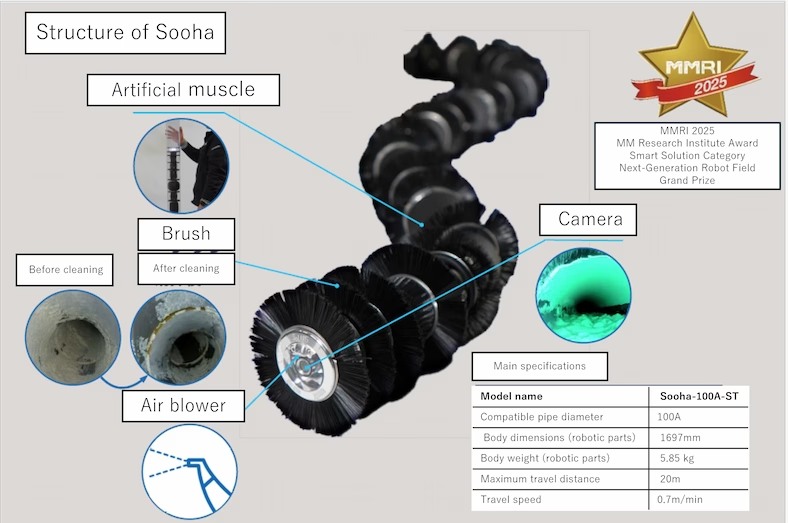
Tozuka: Today, society is facing the serious issue of aging infrastructure—accidents and disruptions to lifelines caused by deteriorating facilities. With repairs expected to be needed across a wide range of facilities in the coming years, there is growing demand for technology that can deliver high-quality maintenance at a low cost and with fewer people. Against this backdrop, we were exploring how we could contribute, based on customer feedback and media reports, when one of our customers introduced us to Solaris, a Chuo University–based startup that developed the earthworm-shaped in-pipe crawling robot Sooha. Through leasing and the trading of used assets, we have long been involved in facility operations for many companies. In that work, we felt a strong need for solutions to address risks in factory piping, such as blockages, leaks, and even fires and explosions. Many of our customers that operate plants and factories told us they were struggling with resource constraints, because pipe inspections require a high level of skill and numerous processes. We concluded that by combining Solaris' unique technology with our know-how in finance and service development, we could help overcome these challenges, which led to this partnership.
—Working with a startup like Solaris must have been a major shift for a company like ours that has traditionally focused on leasing and finance, wouldn't you say?
Tozuka: In our FY2023–FY2025 Medium-term Management Plan, transformation is a key theme, and for this initiative we utilized the Innovation Investment Fund, one of the measures designed to drive that transformation. The fund was established to drive the creation of new services and businesses through open innovation with startups, using investment as a starting point. A major turning point was the shift to a more mobile and flexible framework for decision-making and internal approvals when leveraging the fund, and I strongly felt that the company itself was changing. Without those changes, I don't believe this initiative with Solaris would have been possible.
An Air-driven Robot Specialized for Small-diameter Pipes Is Transforming Maintenance
—What makes Solaris' robot Sooha stand out?
Tozuka: Its greatest feature is that it specializes in small-diameter pipes, using technology no other company has. Pipes are found everywhere, in water and gas systems, factories, plants, railways, commercial buildings, and condominiums, but inspecting and cleaning deep inside particularly narrow and complex piping is difficult with existing technology and services. Sooha mimics the movement of an earthworm, minimizing the twisting of its body while efficiently inspecting the interior of pipes by visually confirming their condition as it moves through multiple ultra-tight bends, and performing cleaning at the same time. Another major advantage is that the robot is powered by air. Compared with electric systems, it offers superior explosion-proof safety, allowing it to be used even in sensitive environments, such as factories that handle materials like petroleum or explosives, where a spark generated by electricity could lead to a serious accident.
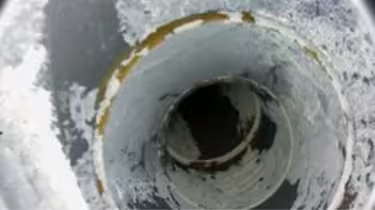
Example use case: semiconductor CVD equipment

No One-off Sales—A Subscription-only Service Designed for Customer Convenience
—By specializing in environments where safety is critical, you are meeting deep needs in a niche area. Is this collaboration model unusual compared with what you have done in the past?
Tozuka: I believe our collaboration with Solaris is a highly distinctive model that fully leverages strengths unique to a company with finance capabilities like ours. Rather than ending with a one-time transaction, such as a lease or sale, this approach provides Solaris' robot as a service designed to help address social issues, and I see it as the most efficient way to do so. Solaris does not sell the robot directly at all; it is offered exclusively through our collaborative, subscription-based model.
—Why did you avoid a one-off sales model and commit to a subscription model?
Tozuka: Purchasing an expensive robot requires careful consideration, so it can take time for customers to make a decision. We chose a subscription model to deliver the robot to customers with challenges as quickly as possible. With no upfront cost, the barrier to adoption is lower. In addition, the monthly service fee includes replacement of consumables, robot maintenance, and the provision of a substitute unit, so customers can always use the robot in proper condition. These are the key reasons we are committed to offering the service in this format.
—Could you summarize the specific roles each company plays?
Tozuka: Solaris focuses on the technical side such as developing and providing robots. Our role, on the other hand, is to own and manage the robot. In addition, we handle everything from managing receivables for customers, invoicing and collecting fees, and arranging insurance coverage—our company's long-standing financial services—to complicated administrative tasks, such as those for paying fixed asset tax. This allows Solaris to concentrate on technological development, while customers have access to an advanced solution for small-diameter pipe inspection without a large upfront investment. This clear division of roles is the core that makes the service work. Solaris has entrusted the heart of its business model to this partnership with us, which demonstrates both the importance of our role and the significant value of the partnership between our two companies.
—Finally, could you share your outlook for the future?
Tozuka: While our roots are in leasing, today we operate a diverse range of businesses aimed at maximizing the value of assets. Looking ahead, we will collaborate with startups and a wide variety of other partners to expand our business domains and deliver solutions that address social issues. Our collaborative model with Solaris is a symbol of that direction. Going forward, we will expand the range of pipe diameters we can support and scale the business to reach new customers beyond the semiconductor field. In terms of business scale, our revenue targets are ¥1.0 billion in 2028, ¥2.8 billion in 2030, and ¥5.0 billion in 2032. Aging pipes and other infrastructure-related troubles seen throughout society are urgent issues. By enabling inspections and cleaning that were not previously feasible, we will provide solutions that support vital social infrastructure.
Note: This article is based on an interview conducted in December 2025.
Departments, figures, and initiatives mentioned are as of the time of the interview.