Environment & Energy
Overview of Environment & Energy
Promoting a decarbonized society as Japan’s leading renewable energy provider
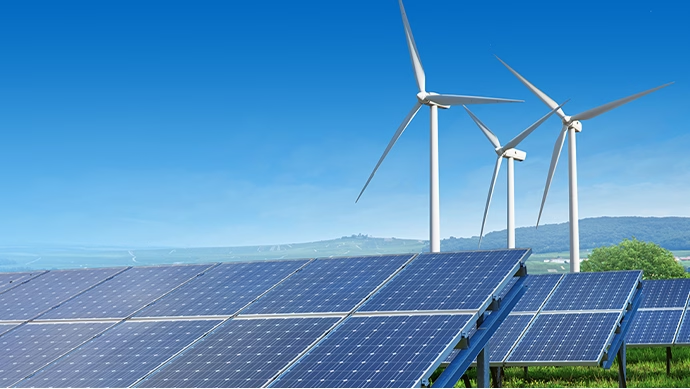
In our Environment & Energy segment, we operate renewable power generation businesses—such as solar and onshore wind— both in Japan and internationally in pursuit of a sustainable society. In addition to providing financing functions in Japan, we are one of the industry's top renewable energy providers, owning one of the largest generation capacities in the industry and supplying green power. Overseas, in addition to our renewable energy power generation business initiatives, which we are pursuing primarily in Europe and the United States, where decarbonization is progressing, we are also involved in next-generation energy businesses that produce green hydrogen and e-methanol derived from renewable energy sources through our portfolio company, European Energy.
- Main business
- Renewable energy business
Strengths of Environment & Energy
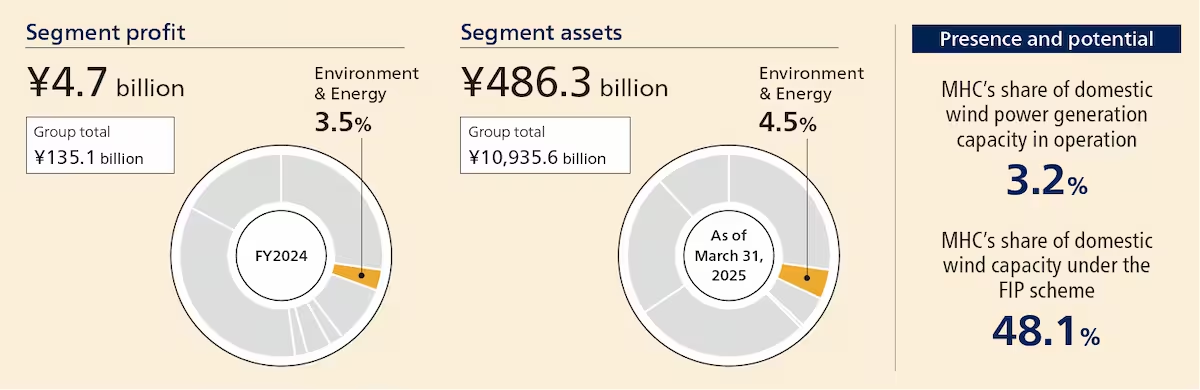
- In Japan, we maintain a leading position in renewable energy generation, with 1.2GW of capacity centered on solar and onshore wind plants.
- We are actively expanding into new businesses, including battery storage, aggregation1, and FIP transitions2.
- Overseas, we invested in European Energy (EE) and began establishing a business foundation to strengthen our development functions.
- 1.Business that manages the supply of electricity generated at power plants and plays a key role in balancing supply and demand by acting as an intermediary between power producers and consumers.
- 2.Refers to transitioning from the feed-in tariff (FIT) scheme to the feed-in premium (FIP) scheme, under which a certain amount of subsidy (premium) is supplemented to the price of renewable electricity sold on the wholesale market.
Environment & Energy Initiatives
Japan
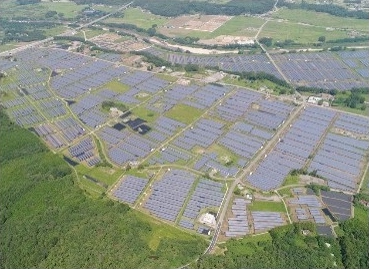
- In solar power generation, we operate businesses to directly supply electricity to customers based on corporate PPAs, in addition to operating power plants using the feed-in tariff (FIT) scheme.
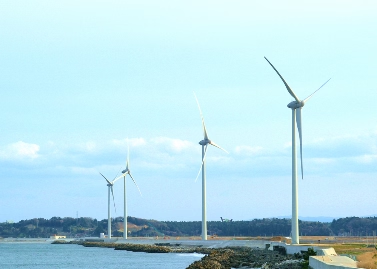
- In onshore wind power generation, we operate power plants using the FIT scheme and the feed-in premium (FIP)1 scheme.
- We strengthen our power generation base by expanding capacity through new projects and by selectively selling assets to improve portfolio quality.
- Beyond electricity sales, we are expanding into new areas such as battery storage to help stabilize the power grid, power-side aggregation (including generation forecasting and supply-demand planning), and transition from FIT to FIP.
- 1.FIP scheme: A certain amount of subsidy (premium) is supplemented to the price of renewable electricity that renewable energy producers sell on the wholesale market, etc.
Overseas
- Overseas, we primarily operate renewable energy power generation businesses—such as solar and onshore wind—in Europe and the US, where decarbonization is advancing.
- In 2024, we invested in EE, a Danish company that operates renewable and next-generation energy businesses, and made it an equity-method affiliate. Through the strategic partnership with EE, we aim to further accelerate and expand our business on a global basis.
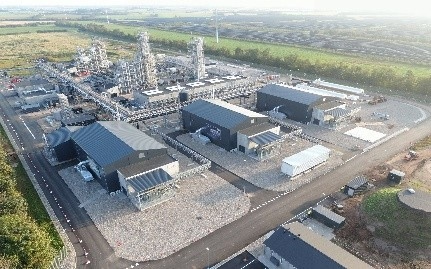
- EE is not only engaged in power generation, but also in next-generation energy businesses that utilize electricity derived from renewable energy to produce green hydrogen and e-methanol. In 2025, the company launched the world’s first and largest commercial-scale e-methanol supply project.