Our Business
Real Estate
Overview of Real Estate
Maximizing the power of real estate and promoting the creation of sustainable social infrastructure
In the Real Estate segment, we operate our business around three core areas: real estate finance, investment, and asset management.
Real estate forms the foundation of people’s lives (homes, commercial facilities, etc.) and of industrial activity (offices, logistics facilities, etc.).
By integrating our three core businesses, we aim to become a player that creates and maximizes social and economic value, while contributing to the development of sustainable social infrastructure.
- Main business
- Real estate financing business
- Real estate investment business
- Real estate asset management business
Strengths of real estate
- By possessing financing, investment, and asset management capabilities, we are able to respond flexibly to changes in the real estate market environment compared to other developers, financial institutions, and other real estate players.
- High level of expertise based on experience in investment, development, and asset management related to income properties, such as offices, hotels, and logistics facilities.
- High recognition as a mezzanine lender and high risk-taking ability based on asset expertise.
Real Estate Initiatives
Main initiatives in the finance business
- We provide financing to projects through various forms such as mezzanine loans and equity investments.
- Target assets are broadly diversified across offices, logistics facilities, hotels, residences, and commercial properties.
- Leveraging our expertise in asset evaluation gained through the investment business, we pursue higher returns by taking on project profitability and real estate price fluctuation risks.
- We have strong sourcing capabilities through diverse channels, including not only sponsors but also financial institutions, real estate players, and our major shareholders' groups.
- We are strengthening initiatives for environmentally and socially conscious assets such as ZEHs,* properties with environmental certifications, lab-equipped offices, and data centers.
- *Net zero energy house: Housing which aims at achieving net zero energy consumption through the reduction of energy use by adopting high-performance insulation and energy-efficient equipment, while generating energy from renewable sources such as solar power.
Property examples of the investment business (real estate development)
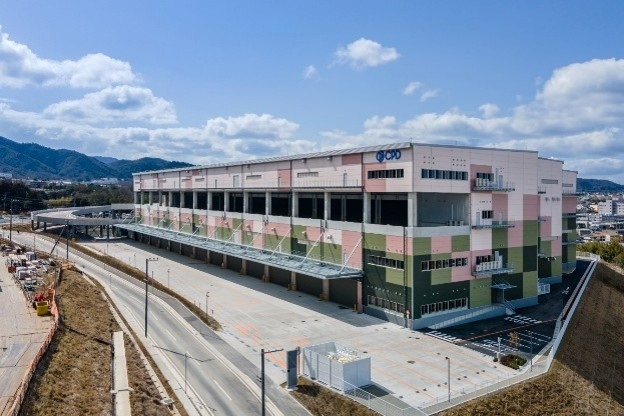
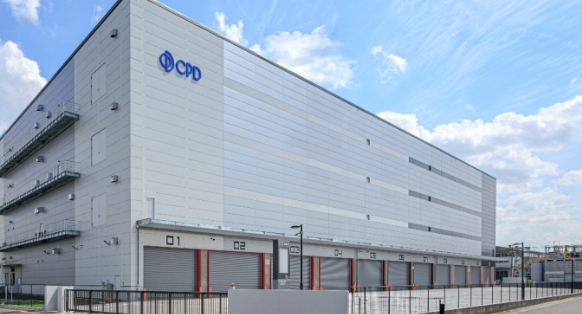
CPD Nishinomiya Kita WEST
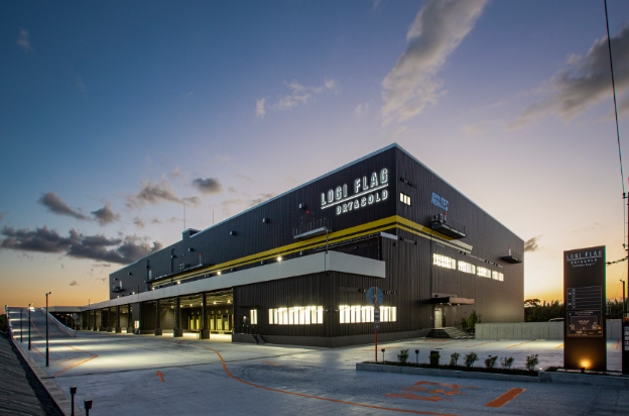
LOGI FLAG DRY & COLD Fukuoka Koga I
Main initiatives in the investment business
- In our investment business, we pursue real estate development and revitalization projects under an asset-turnover model, selling properties after development or value enhancement.
- Development projects include large-scale logistics facilities, multi-tenant cold storage warehouses, and mixed-use complexes comprising offices, hotels, and retail spaces in collaboration with business partners.
- Revitalization investments involve acquiring properties with issues such as aging or deterioration and enhancing their value through both soft and hard measures—such as energy cost reduction, equipment upgrades, and renovations—before selling.
In hotel investments, we work with operators to enhance property value through initiatives such as operator changes, rebranding, and the adoption of global-standard management outsourcing schemes.*
- *A scheme called the management contract method. Property owners outsource hotel operations to operators, such as the dispatch of general managers and other management staff, brand management, provision of know-how, and sales business.
Property examples of the investment business (revitalization)
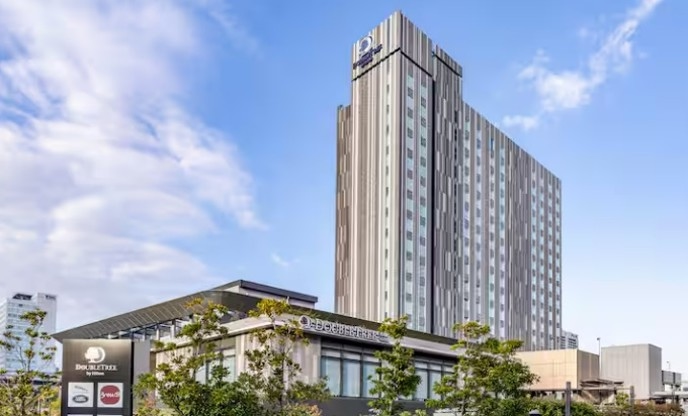
Double Tree by Hilton Tokyo Ariake

- To maximize hotel value by leveraging prime locations with excellent accessibility and rare scale and specifications, we partnered with business collaborators to bring in Hilton, a leading global hotel chain, as the operator.
- The hotel was rebranded as Double Tree by Hilton Tokyo Ariake and opened in 2024.
Main initiatives in the asset management business
- We operate and manage private funds and private REITs targeting offices, logistics facilities, hotels, residences, and commercial facilities.
- We build a real estate value-chain model—from acquisition through development or revitalization to exit—by selling properties acquired through our investment business to private funds and private REITs formed by other investors.
- To strengthen our asset management and development capabilities in logistics facilities, we made Center Point Development a wholly owned subsidiary in 2023 and established LOGI FLAG DEVELOPMENT, as a joint venture with a partner company in 2024.
- Mitsubishi HC Capital Realty Advisers has obtained a GRESB* rating, a global ESG benchmark, and aims to further improve its score through enhanced initiatives.
- *An organization that conducts benchmarking assessments to measure the ESG performance of real estate and infrastructure companies and funds.
It was founded in 2009 by a group of major European pension funds who played leading roles in launching the Principles for Responsible Investment (PRI).
Property examples of the asset management business
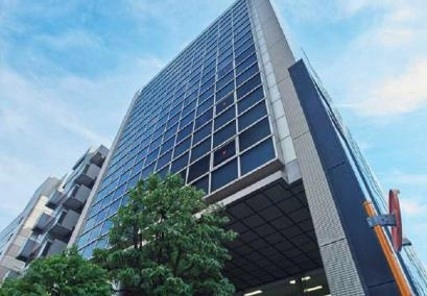
(office building)

(commercial building)
[Reference] Market size of real estate securitization in Japan
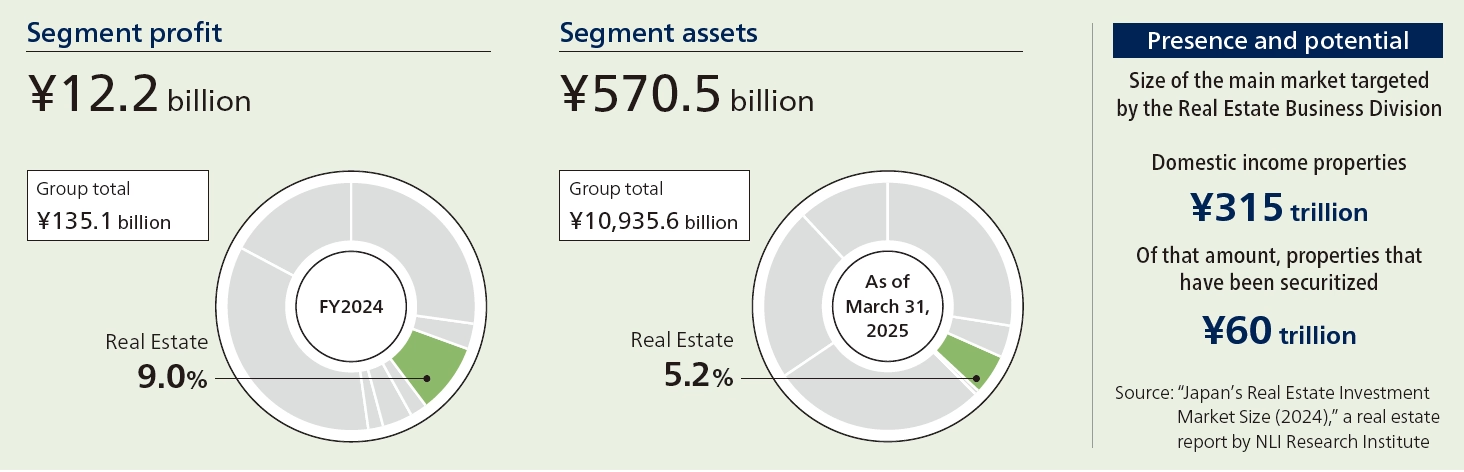
- While the income property market in Japan is valued at approx. ¥315 trillion*, the value of securitized real estate stands at around ¥66 trillion, indicating significant growth potential for the securitized real estate market. The US commercial real estate market is about $20 trillion, suggesting that Japan’s market still has substantial room for expansion relative to GDP.
- *“Japan’s Real Estate Investment Market Size (2024),” a real estate report by NLI Research Institute.
![Graph of [Market size of real estate securitization in Japan] 29 trillion yen in 2015 66 trillion yen in 2024](/english/corporate/business/img/estate_im09.avif)
[Reference] Market size of income-producing property transactions in Japan (by buyer attribute)
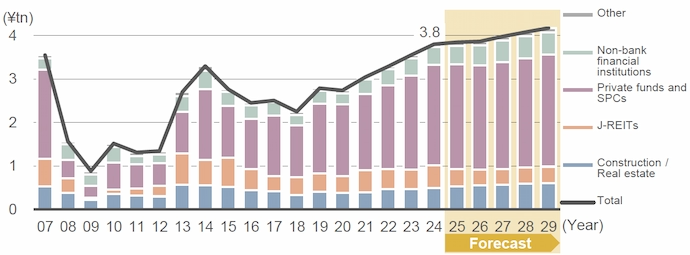
- Although the real estate transaction market temporarily slowed, it has been expanding since 2021 and gradual expansion is expected to continue.